Last week, my cooperating teacher and I implemented a lesson that was exceptionally engaging and rigorous. In an effort to prepare our students for the coming standards that mandate a much higher level of text analysis, we decided to borrow a close reading technique that I learned from the educon conference. Try the link for a number of excellent text based discussion methods. We used the story, Liberty, by Julia Alvarez, though any text would work. Students were asked to complete the reading outside of class. While reading, they had to find and underline examples of each of the following: - [RL.9-10.1] Find, underline, and mark a sentence that requires you to use inference to understand the meaning. In other words, find a sentence in which you need to read between the lines.
- [RL.9-10.2] Find, underline, and mark a sentence that shapes or refines the theme of the story. In other words, find a sentence that drives the underlying meaning of the text.
- [RL.9-10.3] Find, underline, and mark a sentence that shows the development of a character from Liberty. How does the author develop that character? How does that character advance the plot or develop the theme?
- [RL.9-10.4] Find, underline, and mark a word or phrase that impacts the meaning or tone of the story. It can include a figurative or connotative meaning. (e.g how the language evokes a sense of time and place; how it sets a formal or informal tone).
- [RL.9-10.6]Find, underline, and mark a sentence that shows a point of view or cultural experience from outside the United States.
The text and assignment were given out on Monday. On Wednesday, the class brought their materials and gathered in groups of four. One student presented their inference quote. Each student in the group commented on that quote. When everyone had cited and discussed their choice, the group had to decide which example best elucidated the requirement. After the small group work, we discussed their final choices as a class. This lesson really helped my sophomores understand how to find text to support their assertions. It also helped them to do a close reading to analyze for language, theme, and plot. We deliberately chose a reading that would be easy for them to comprehend because the concepts we were teaching were complex. In the future, we plan to implement this lesson with more challenging texts. Liberty Lesson
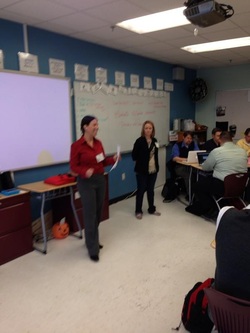
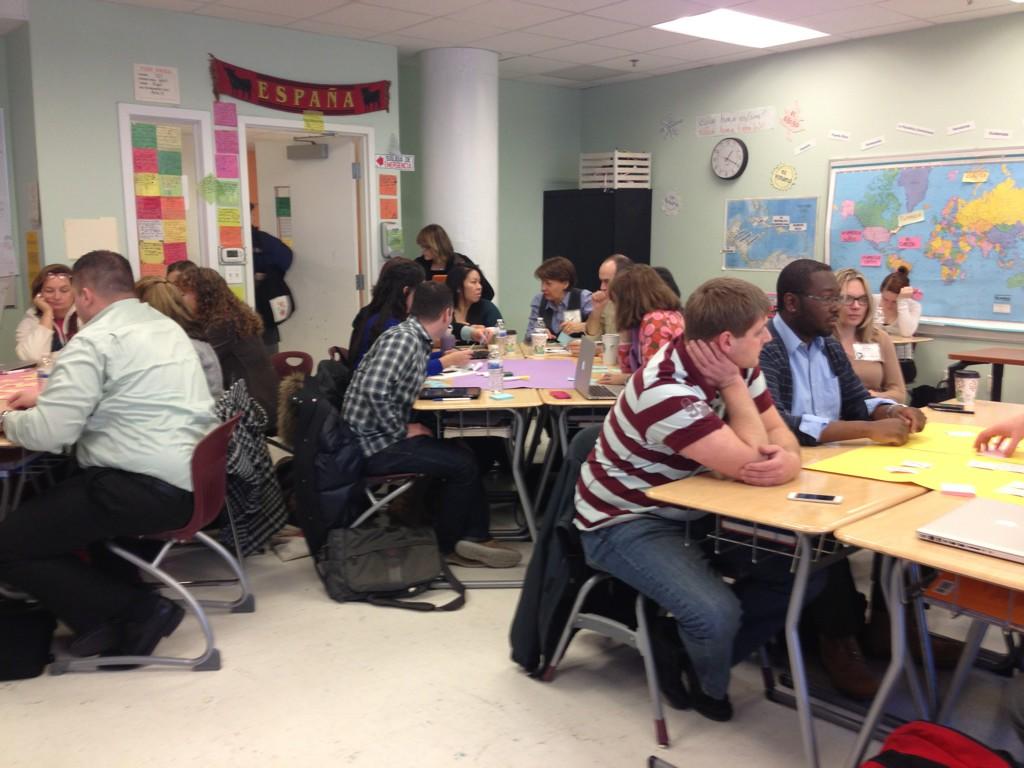
Educon. Wow! Is there any other educational conference like it? This is my second year, and I was once again profoundly impacted in my pedagogy and practice. I left the conference feeling invigorated- excited once again to be part of this incredible profession. This year, I decided to try my hand at facilitating a conversation along with Dr. Spike Cook and Dana Sirotiak. Together with our amazing group, we discussed and redefined the meaning of disruptive and sustained technology and the impact they have on education. What a privilege to be a part of such an innovative discussion! It is incredible to me that educators from around the world travel to this two-day weekend event. The people who do are intelligent, innovative, and articulate educators who are passionate about educational reform. I love to see the change on newcomers faces when they realize that this isn't just another education conference. This is intellectual conversations; high-participation sessions; educators working towards real educational change. This is educon.
Here is a video highlighting how our school implemented student created TED talks for our Senior ELA curriculum. This was a fabulous project that combined reading informational, research, expository writing, speaking, listening, and evaluating. It was a semester long, challenging, rigorous and FUN unit for our students. Want to know more about this project? Read here. The rubrics and handouts will be posted on this link ASAP.
Interested in finding out how one school restructured their 9-12 ELA curriculum to meet the Common Core State Standards? Want some ideas for adding project based learning to your lessons? Here is a link to a webinar from edWeb and ePals explaining how my school, Burlington County Institute of Technology, facilitated the transition from the NJ Core Curriculum Standards to the CCSS. It also features some ideas for implementing the CCSS into the middle and elementary grades. Links from the webinar: Curriculum
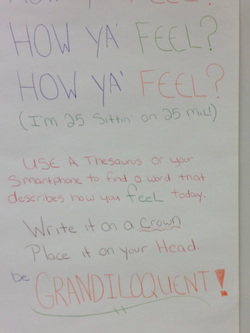
(I'm 25 sittin' on 25 mil.) Here is a vocabulary lesson I implemented in class today. The students had a lot of fun with it. My goal for this year is to expose the students to as much vocabulary as possible, given that it is pivotal to their reading comprehension and writing skills. I like to have them use a variety of words without necessarily testing them on all of them. This lesson only took 15 minutes, yet I think the students were introduced to a plethora of new words. CCSS.ELA-Literacy.L.9-10.6 Acquire and use accurately general academic and domain-specific words and phrases, sufficient for reading, writing, speaking, and listening at the college and career readiness level; demonstrate independence in gathering vocabulary knowledge when considering a word or phrase important to comprehension or expression. Objective: I can demonstrate independence in gathering vocabulary knowledge when considering a word important to expression. As the students arrived to class, I greeted them at the door with a crown on my head. My crown read, "Captivated," and it had some symbols and a + sign. They asked why I was wearing this crown. I told them that I was feeling captivated right now by the brilliance and beauty of my students. The students were instructed to use a thesaurus or dictionary.com to find a word that accurately described how they were feeling at the moment. After they found their word, they made their own crowns. Throughout the class period, I would call on a student randomly and ask them to elaborate on their feeling. Each student, at some point during the lesson, had a chance to explain how they were feeling.
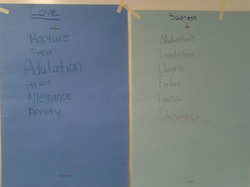
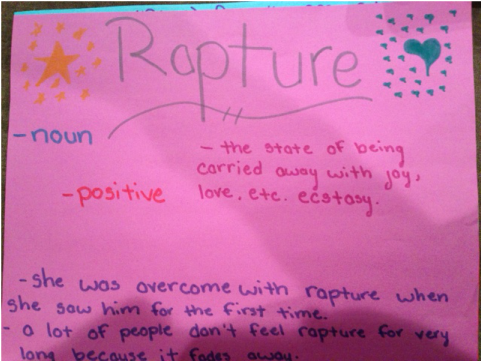
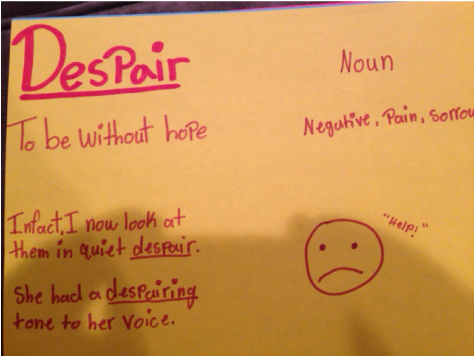
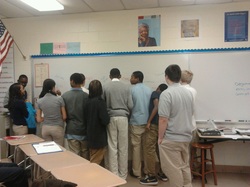
Here is a vocabulary lesson plan that went particularly well with my freshmen students. We are about to study a unit on the Coming of Age novel. The summative assessment is for the students to write a personal narrative about their own "moment of knowing." After they write the narrative, they will create an iMovie telling their story. Before they wrote the narratives, I wanted them to expand their vocabulary with regards to emotions. This is the lesson I created. CCSS.ELA-Literacy.L.9-10.4b Identify and correctly use patterns of word changes that indicate different meanings or parts of speech (e.g., analyze, analysis, analytical; advocate, advocacy). CCSS.ELA-Literacy.L.9-10.5b Analyze nuances in the meaning of words with similar denotations. Each student was given a notecard with a word on it. Each word was a synonym for Love, Hate, Shame, Sadness, or Happiness. Using an 8X10 sheet of paper, students wrote the denotation, the connotation, part of speech, a symbol, at least three forms of the word, and two sentences using the various forms of the word. I placed large sheets of paper around the room. Students were then instructed to gather around the sheet that contained the synonym of their word. They had to share the denotation and rank the words from most positive to most negative connotation. They finished by presenting their words and rankings to the class. It went great! The students were engaged and really intense in their discussions on the nuances of the words and their meanings. It exposed them to a wide range of words for their writing and the understanding that language is rich and varied.
I attended an excellent workshop today at the Delaware Valley Minority Consortium. The presenter was from Rockville Centre in Long Island. At their South Side School District, they abolished tracked classes. All students are now in honors level classes. Their position is that all students deserve the best curriculum. Though this program was initially met with resistance and even some animosity from both faculty and parents, it has achieved great success. They have virtually closed their achievement gaps with regards to the number of students graduating with a Regents Degree. Though there was initially a 60 point variation between their white/asian and their black/hispanic population, the gap is now less than 3%. How many districts can make claims like that? Additionally, their highest and middle of the road students increased in academic completion. To what do they attribute this great success? A variety of things, including teacher training, improvement in overall best practices, and a rigorous and relevant curriculum. This is a revolutionary idea. Honors for all? Imagine the difference if lower achieving students were no longer placed on a trajectory that virtually ensured failure in educational endeavors? Imagine the difference in the life of a child if we truly believed that all students could achieve academic success? For more information, read here.
I wanted to share a lesson plan based on the Common Core Standards, grade 9 ELA. I'd also like to see if another classroom is willing to participate in an online discussion at the conclusion of the lesson. EQ: What does it mean to be alienated in society? Standards: CCSS.ELA-Literacy.RL.9-10.7 Analyze the representation of a subject or a key scene in two different artistic mediums, including what is emphasized or absent in each treatment. CCSS.ELA-Literacy.SL.9-10.1a Come to discussions prepared, having read and researched material under study; explicitly draw on that preparation by referring to evidence from texts and other research on the topic or issue to stimulate a thoughtful, well-reasoned exchange of ideas. Agenda: 1. Read (as a class) "The Yellow Wallpaper" by Charlotte Perkins Gilman. Briefly discuss. 2. Distribute lyrics to "I'm Just a Girl," by No Doubt. Listen. 3. Have students (in pairs) do a close reading of both texts. Using highlighters to note and annotate similarities and differences in subject among both texts. (We will be using google docs for this). 4. Prepare 3 levels of questions for Socratic Seminar (see seminar blog post). 5. Participate in face to face (or online) Socratic discussion of the texts and their relation to alienation and equality. We would like to complete this lesson plan and, if possible, hold an online discussion with another class during the week of November 12-16th, between 9:45 and 11:00 EST. Interested?
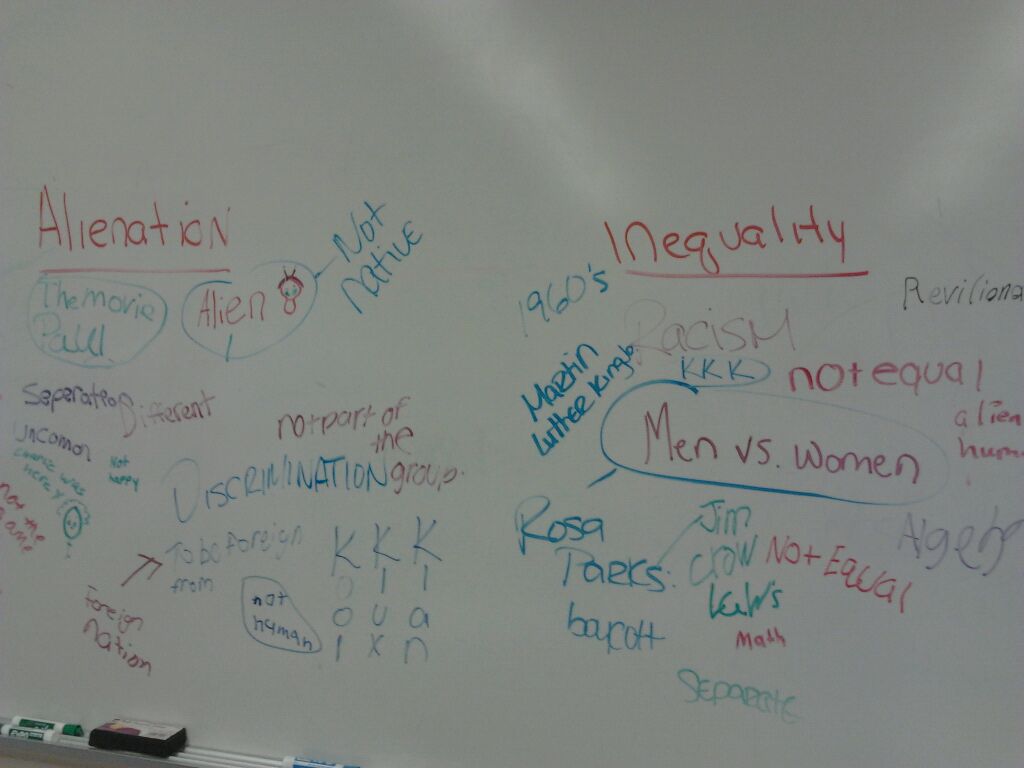
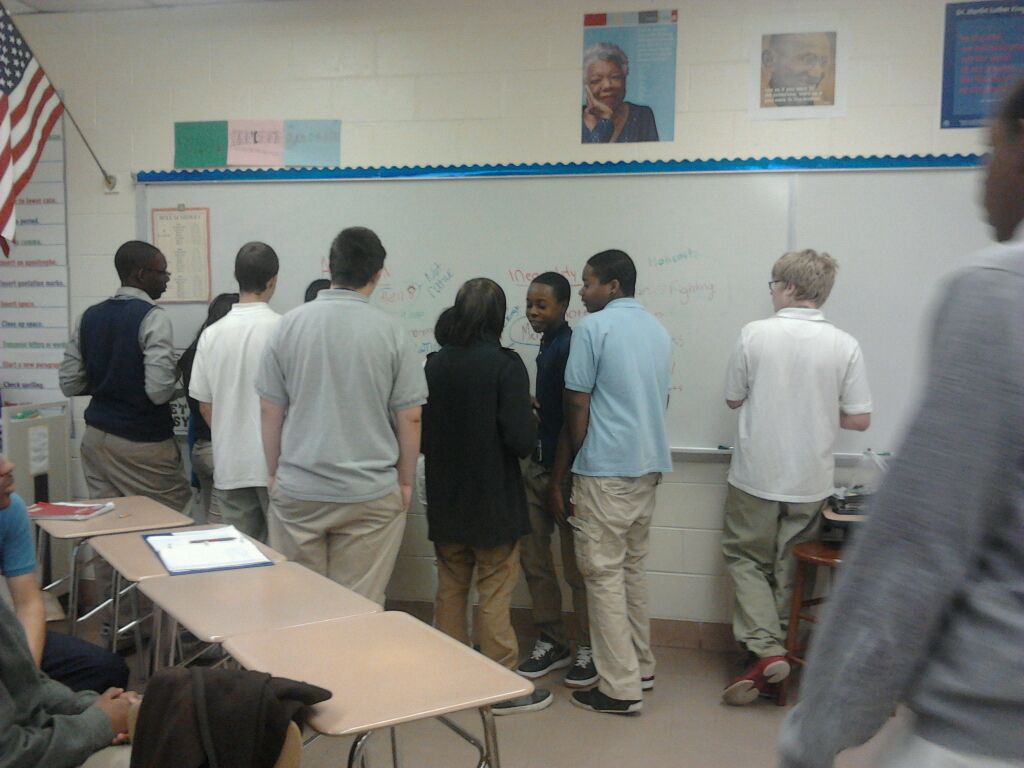
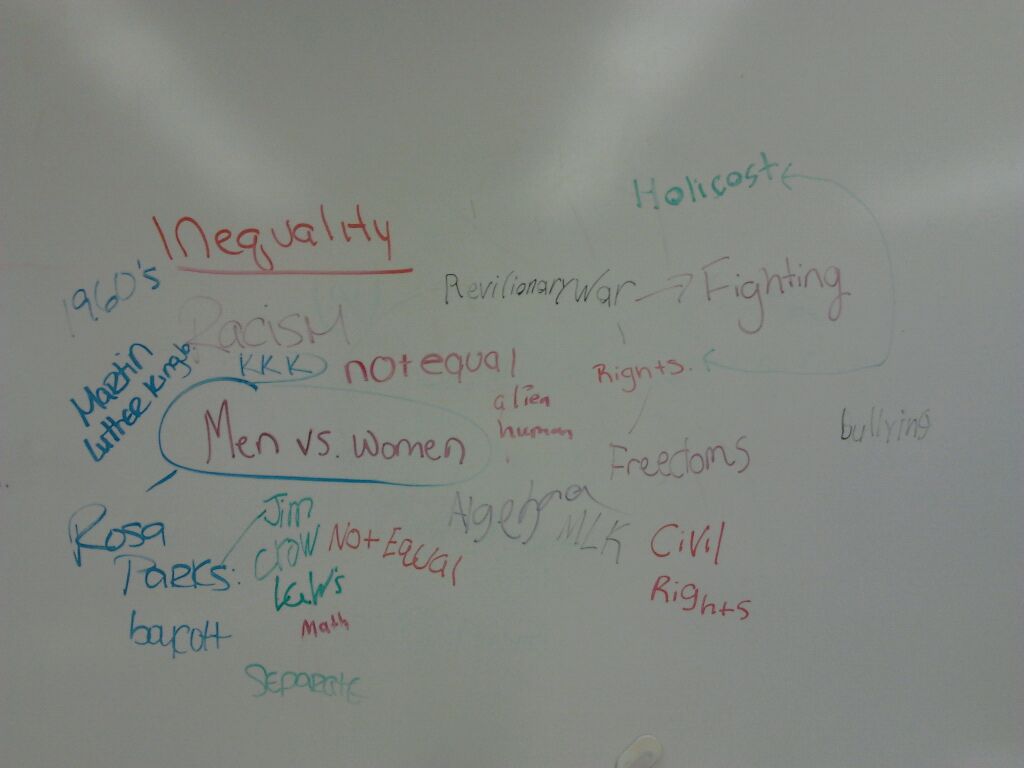
Silent Chalk Talk is a classroom activity that I picked up at the most excellent Educon conference last year. Since the conference, I have used this method in my class several times, each time with great success. I have found it to work best as an introductory activity, allowing students to explore their background knowledge and perspectives on a given subject. It works like this: 1. Using a white (or chalk) board, or a mural size paper, write a few "big ideas." The last time we used the activity, our topics were Alienation and Inequality.2. Students must remain absolutely silent. The free write their ideas around the big ideas on the board. I encourage the students to circle ideas and connect them to other ideas where relevant. 3. I allow my students some time for this activity. The step up, write, step back, think, step up, connect, etc. 4. Finally, we use the notes as a springboard for our discussions, especially noting the connections made. For more information on this activity, click here.
The Common Core State Standards (rightly so) place a high emphasis on vocabulary and vocabulary strategies. Knowing that this is one of the harder things to teach well, and knowing that our students struggle with text complexity due to this, we came up with some strategies to assist our students in learning new vocabulary. Here are the standards related to vocabulary: CCSS.ELA-Literacy.RL.9-10.4 Determine the meaning of words and phrases as they are used in the text, including figurative and connotative meanings; analyze the cumulative impact of specific word choices on meaning and tone (e.g., how the language evokes a sense of time and place; how it sets a formal or informal tone). CCSS.ELA-Literacy.RI.9-10.4 Determine the meaning of words and phrases as they are used in a text, including figurative, connotative, and technical meanings; analyze the cumulative impact of specific word choices on meaning and tone (e.g., how the language of a court opinion differs from that of a newspaper). - CCSS.ELA-Literacy.L.9-10.4 Determine or clarify the meaning of unknown and multiple-meaning words and phrases based on grades 9–10 reading and content, choosing flexibly from a range of strategies.
- CCSS.ELA-Literacy.L.9-10.4a Use context (e.g., the overall meaning of a sentence, paragraph, or text; a word’s position or function in a sentence) as a clue to the meaning of a word or phrase.
- CCSS.ELA-Literacy.L.9-10.4b Identify and correctly use patterns of word changes that indicate different meanings or parts of speech (e.g., analyze, analysis, analytical; advocate, advocacy).
- CCSS.ELA-Literacy.L.9-10.4c Consult general and specialized reference materials (e.g., dictionaries, glossaries, thesauruses), both print and digital, to find the pronunciation of a word or determine or clarify its precise meaning, its part of speech, or its etymology.
- CCSS.ELA-Literacy.L.9-10.4d Verify the preliminary determination of the meaning of a word or phrase (e.g., by checking the inferred meaning in context or in a dictionary).
- CCSS.ELA-Literacy.L.9-10.5 Demonstrate understanding of figurative language, word relationships, and nuances in word meanings.
- CCSS.ELA-Literacy.L.9-10.6 Acquire and use accurately general academic and domain-specific words and phrases, sufficient for reading, writing, speaking, and listening at the college and career readiness level; demonstrate independence in gathering vocabulary knowledge when considering a word or phrase important to comprehension or expression.
What are our strategies? 1. Vocabulary Strategies Graphic: We created this graphic (with assistance from Standards Solutions) for each student. Every day we have the word of the day. A word is put on the board either in context, defined, or examples. Students use their strategies graphic to assist them in figuring out the denotation and connotation of each word. 2. We do activities where the students look at vocabulary patterns of changes or commonly confused words. 3. We have students revise writing to replace common words with more colorful words from the thesaurus.
4. We have students brainstorm all of the possible words related to another word, and then as a group, we make a list based on connotation. For example: Love
Rapture Passion Enchantment Devotion Infatuation Affection Tenderness
And so on. This allows students to use a common word (love), and examine how connotation plays a large role in word choice and meaning.
5. We look at the evolution of language through newly added dictionary words, and words no longer in use (groovy, huh?).
6. And, yes, we are hitting them hard with grammar. Most of the mistakes in usage come from not understanding the part of speech. We are working to make this an every day activity for them so that they can quickly use a word correctly.
|